
Ford Fiesta: Fuel Tank and Lines - 1.6L EcoBoost (132kW/180PS) – Sigma / Fuel Tank. Removal and Installation
Ford Fiesta 2014 - 2019 Service Manual / Fuel System / Fuel Tank and Lines - 1.6L EcoBoost (132kW/180PS) – Sigma / Fuel Tank. Removal and Installation
Special Tool(s) / General Equipment
| Hose Clamp(s) | |
| Powertrain Jack |
Removal
NOTE: Removal steps in this procedure may contain installation steps.
-
With the vehicle in NEUTRAL, position it on a hoist.
Refer to: Jacking and Lifting - Overview (100-02 Jacking and Lifting, Description and Operation).
-
Release the fuel system pressure.
Refer to: Fuel System Pressure Release (310-00B Fuel System - General Information - 1.6L EcoBoost (132kW/180PS) – Sigma, General Procedures).
-
Drain the fuel tank.
Refer to: Fuel Tank Draining (310-00B Fuel System - General Information - 1.6L EcoBoost (132kW/180PS) – Sigma, General Procedures).
-
Remove the rear seat cushion.
Refer to: Rear Seat Cushion (501-10 Seating, Removal and Installation).
-
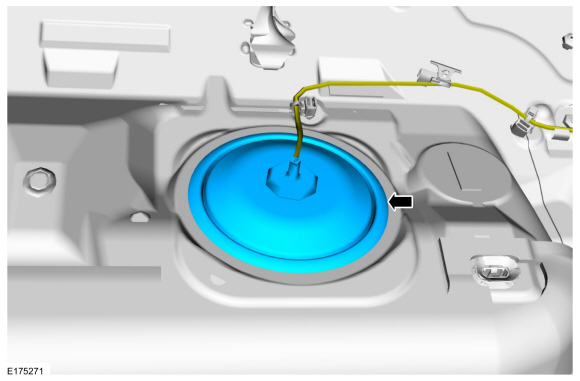
Remove the cover.
 |
-
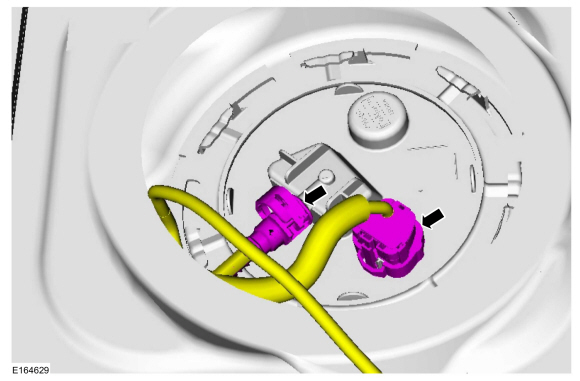
Disconnect the electrical connector and the fuel line quick release coupling.
Refer to: Quick Release Coupling (310-00B Fuel System - General Information - 1.6L EcoBoost (132kW/180PS) – Sigma, General Procedures).
 |
-
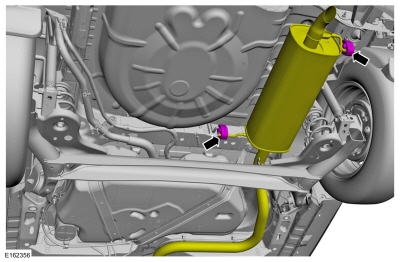
Disconnect the insulators and position aside the exhaust.
 |
-
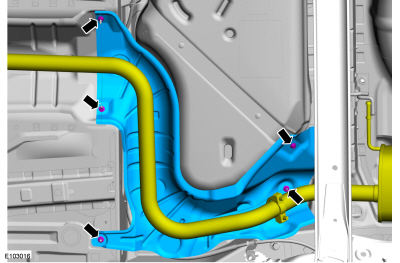
Remove the retainers and shield.
 |
-
-
Clamp off the fuel filler pipe hose.
Use the General Equipment: Hose Clamp(s)
-
Release the clamp and position aside the filler pipe hose.
-
Disconnect vapor line quick release coupling and position aside.
Refer to: Quick Release Coupling (310-00B Fuel System - General Information - 1.6L EcoBoost (132kW/180PS) – Sigma, General Procedures).
-
Clamp off the fuel filler pipe hose.
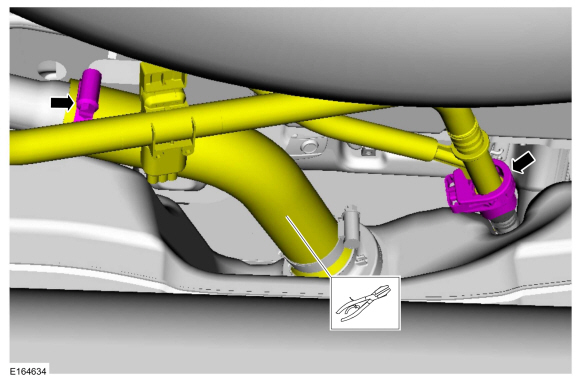 |
-
Remove and discard the fuel tank strap bolts.
Use the General Equipment: Powertrain Jack
Torque: 18 lb.ft (25 Nm)
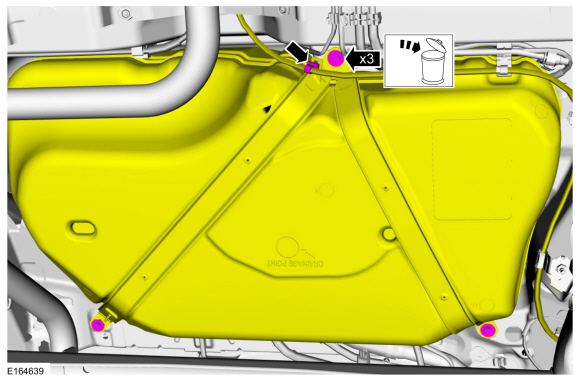 |
-
Lower the fuel tank far enough to disconnect the vapor line. Remove the fuel tank.
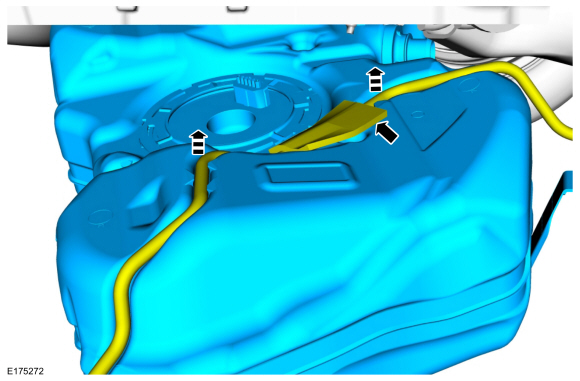 |
Installation
-
To install, reverse the removal procedure.
 Fuel Tank and Lines - Overview. Description and Operation
Overview
Fuel Tank and Lines
The fuel tank and lines consist of the following:
single container fuel tank.
lifetime in tank fuel filter (serviced as part of the fuel pump)...
 Fuel Level Sender. Removal and Installation
Removal
NOTE:
Removal steps in this procedure may contain installation details.
Remove the Fuel Pump and Sender Unit.
Refer to: Fuel Pump and Sender Unit (310-01B Fuel Tank and Lines - 1...
Other information:
Ford Fiesta 2014 - 2019 Service Manual: Pyrotechnic Device Health and Safety Precautions. Description and Operation
WARNING: Service and handling of Pyrotechnic Components is restricted to qualified personnel. The required qualifications vary by region. Always observe local laws and legislative directives regarding Pyrotechnic Components service and handling...
Ford Fiesta 2014 - 2019 Service Manual: Exterior Front Door Handle. Removal and Installation
Removal NOTE: LH side shown, RH side similar. Remove the access plug and loosen the exterior front door handle retaining screw. Remove the exterior front door handle cover and if equipped the front door lock cylinder...
Categories
- Manuals Home
- Ford Fiesta Service Manual (2014 - 2019)
- Engine. Assembly
- Manual Transmission, Clutch, Transfer Case and Power Transfer Unit
- Brake System
- Jacking and Lifting - Overview. Description and Operation
- Engine - 1.6L EcoBoost (132kW/180PS) – Sigma
Rear Wheel Speed Sensor. Removal and Installation
Removal
NOTE: Removal steps in this procedure may contain installation details.
Remove the retainer and pull the rear splash shield outward.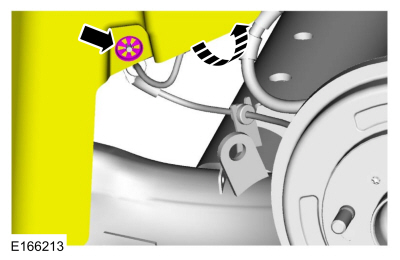 Disconnect the electrical connector and detach the wiring retainer.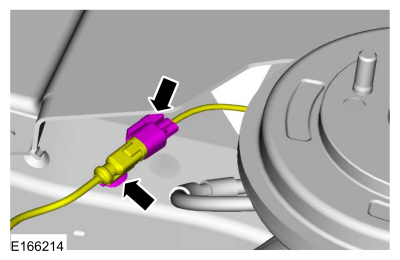

Copyright © 2026 www.fofiesta7.com